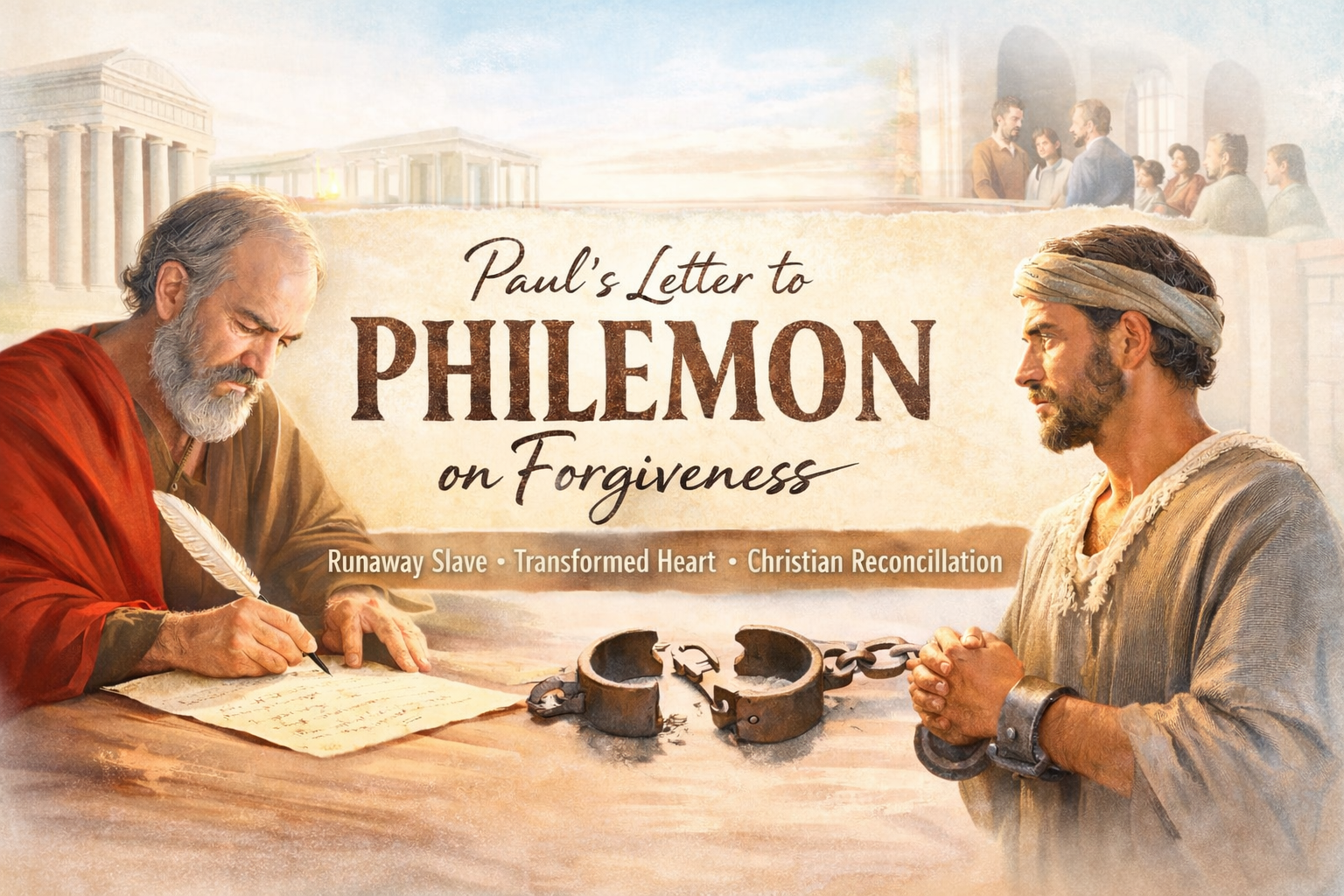
Forgiveness that Frees: Paul’s Letter to Philemon
Forgiveness sounds simple… until it costs something.
It’s easy to forgive when the hurt is small. It’s harder when the wound is deep. It’s even harder when the person who hurt you shows up again and expects a response.
That is exactly why Paul’s letter to Philemon on forgiveness matters so much. This short New Testament letter is only one chapter long, but it gives us one of the clearest pictures of Christian forgiveness and reconciliation in real life. It’s personal. It’s emotional. And it’s deeply practical.
And it forces one big question: What do you really believe about Christ… and will you live like it?
What Is the Book of Philemon About?
If you’ve ever wondered what the book of Philemon is about, the answer is simple: It’s a letter about forgiveness that becomes personal.
It’s not written as a church-wide teaching letter like Romans. Instead, it’s a personal appeal from Paul to one believer named Philemon. That’s what makes it so powerful.
Philemon is short enough to read in one sitting, but deep enough to challenge your heart for a lifetime.
Paul’s Letter to Philemon: The Story Behind the Letter
Philemon was a prominent leader in Colossi. He hosted a church in his home. Scripture even mentions his wife, Apphia, and refers to:
“the church that meets in your house.” – Philemon 1:2
In other words, Philemon wasn’t just a Christian in name. He was known.
Paul even tells him:
“I have heard of your love and faithfulness, which you have both for the Lord Jesus and for all God’s people.” (Philemon 1:5)
And again:
“The hearts of God’s people are refreshed by your actions, my brother.” (Philemon 1:7)
Philemon had a reputation for strengthening others. But now his faith was about to be tested in a way that wasn’t theoretical.
It was personal.
Onesimus and Philemon: The Conflict That Made Forgiveness Costly
In verse 10, Paul introduces a man named Onesimus. His name means “useful.” But Onesimus had a complicated past.
He was Philemon’s slave, and he had escaped. Somehow, he ended up with Paul in Rome, where Paul led him to Christ.
Paul writes:
“I became his father in the faith while here in prison.” (Philemon 1:10)
This is where the story shifts because Paul is not writing about an idea. He is writing about a person. Then Paul says something that makes the weight of this letter impossible to ignore:
“I am sending him—who is my very heart—back to you.” (Philemon 1:12)
Onesimus was going back.
Back to the man he wronged.
Back to the consequences.
Back to the question of whether grace was real.
Paul and Onesimus: A Gospel-Shaped Relationship
Paul doesn’t just speak of Onesimus as a servant. He speaks of him like family. That matters.
Because Paul is modeling what the gospel does. It changes the way we see people and what we call them. And it changes what we believe is possible.
Paul’s Letter to Philemon on Forgiveness: No Longer a Slave
Paul gently, but boldly, challenges Philemon with these words:
“Perhaps this is the reason he was separated from you for a little while, so that you might have him back forever—no longer as a slave, but better than a slave, as a dear brother.” (Philemon 1:15–16)
This wasn’t just about a runaway servant. It was about whether Philemon would treat Onesimus the way the world treated people…
Or the way Christ does. Paul goes even further:
“So if you consider me a partner, welcome him as you would welcome me.” (Philemon 1:17)
That is a stunning request. Paul is asking Philemon to look at Onesimus, his runaway slave, and see a brother, not property.
What Paul Actually Asks Philemon to Do
Paul’s request is clear. He asks Philemon to:
- Receive Onesimus back
- Treat him as a brother in Christ
- Let love lead the decision
- Choose mercy instead of punishment
Paul even offers to cover any loss Onesimus caused:
“If he has done you any wrong or owes you anything, charge it to me.” (Philemon 1:18)
This is what peacemaking looks like. Paul steps into the mess and offers peace.
These Prayer Cards for Moms include a Bible verse and a prayer to uplift, encourage, and draw your heart closer to God—right when you need it most.
Whether you’re starting your day with quiet time, encouraging a friend, or tucking truth into your journal, these prayer cards—with Scripture on each one—will gently remind you of God’s presence, strength, and unending love in every season of motherhood.
The Detail That Makes This Story Hit Hard
One of the most powerful details in this letter is easy to miss. Onesimus delivered the letter himself. That means he stood there while the church gathered.
He listened as the words were read aloud. He heard every line. And he probably wondered:
Will I be forgiven?
Will I be punished?
Will I be welcomed?
Philemon could have had him executed. Or he could have treated him as family.
Philemon Forgiveness: When Faith Becomes Personal
If you feel stuck in resentment, pain, or uncertainty, the book of Philemon offers hope.
It shows what forgiveness looks like when it’s lived out in a relationship that actually matters.
Because forgiveness is not proven by what we say. It’s proven by what we do.
Christian Forgiveness and Reconciliation Will Cost You Something
Luke 14 gives us a hard but necessary truth. Jesus says
“Whoever does not carry their cross and follow me cannot be my disciple.” (Luke 14:27)
Philemon’s decision would cost him something.
Forgiveness always does.
Grace always does.
Love always does.
But the cost is worth it when it reflects Christ.
10-Day Devotional: Embracing God’s Hope in Hard Times: A printable devotional for busy Christian women seeking hope, healing, and transformation through God’s Word.
With daily scriptures, prayers, and journaling prompts, you’ll renew your mind and refocus on Christ—no matter what season you’re in.
Grab your copy of”Embracing God’s hope in Hard Times” and start experiencing the peace and clarity you’ve been craving.

The Question at the Heart of Paul’s Letter to Philemon
At the heart of this story is a simple challenge: What do you really believe about Jesus?
Because belief always shows up in behavior. It’s easy to talk about faith when life is calm.
But when someone hurts you… when someone disappoints you… when someone returns asking for mercy… That’s when faith becomes real.
Philemon had to choose: Will I treat Onesimus like the world does… or like Christ does?
Paul’s Letter to Philemon on Forgiveness: Key Lessons for Today
Forgiveness Starts With How You See People
Paul’s letter reminds us that forgiveness begins in the mind. You cannot forgive someone you refuse to see as human.And, you cannot forgive someone you refuse to believe God can change.
Psalm 139 reminds us that God sees every person deeply:
“You have searched me, Lord, and you know me.” (Psalm 139:1)
God knows the whole story. He knows the hidden pain. God knows the places people have been shaped by brokenness.
That doesn’t excuse sin.
But it helps us hold truth and mercy together.
Forgiveness Is Active, Not Vague
Forgiveness is not just a feeling. It is a decision.
If Paul doesn’t ask Philemon to quietly “move on.” He asks him to welcome Onesimus. To receive him. To treat him differently. That is active forgiveness.
Sometimes your step is not big; it’s simply:
- choosing not to speak harshly
- refusing to rehearse the offense again
- praying instead of plotting revenge
Forgiveness Often Needs Community Support
Philemon wasn’t alone. The church met in his home. That means forgiveness would be witnessed.
That can feel heavy. But it can also be healing. Sometimes we need one trusted believer who will pray with us, not gossip about us. Forgiveness grows stronger in godly support.
Forgiveness Can Include Boundaries
Forgiveness does not mean pretending nothing happened. Boundaries protect what is sacred. They protect your peace. Boundaries protect your home.
Sometimes boundaries are wise when:
- safety is at risk
- harm has been repeated
- repentance is missing
Forgiveness releases bitterness. Boundaries protect peace. Both can exist together.
Forgiveness Frees the One Who Releases It
Resentment is exhausting. It drains time, energy, and emotional strength. Forgiveness is not always instant, but it is freeing. Jeremiah 18 reminds us that God is shaping hearts like clay:
“Like clay in the hand of the potter, so are you in my hand.” (Jeremiah 18:6)
God can reshape your heart too. He can soften what pain hardened. He can heal what bitterness bruised. Forgiveness becomes worship when you trust God with justice.
Forgiveness That Reflects the Gospel
The book of Philemon is short, but it carries a heavy message. Forgiveness is not just a spiritual idea. It is a real decision that shows what we believe about Jesus.
Paul’s letter to Philemon on forgiveness teaches us that:
- forgiveness starts with how we see people
- forgiveness is active, not vague
- forgiveness may require boundaries
- forgiveness frees the one who releases resentment
- forgiveness reflects the gospel in real relationships
And at the center of it all is Onesimus. A man with a past who is standing in the room while the letter is read. A man wondering whether grace will win.
This story reminds us that faith is not proven by what we say. It is proven by what we do.
So today, read Philemon again. Pray one honest prayer. And take one next step toward peace. Even if it’s small.
God can do a lot with one willing heart.
Interested in Bible Art Journaling?
Looking for a creative way to express your journey of loving God? Our “FREE Loved By God Bible Art Elements” offer beautiful and inspiring resources to enhance your Bible journaling experience. These elements are designed to help you visually celebrate and reflect on God’s love, adding a personal and artistic touch to your spiritual practice. Explore how these art elements can deepen your connection with God and enrich your study time.

You might enjoy these similar blog posts:
Embracing God’s Hope: 10 Scriptures for Hard Times
The Power of Prayer
Praying for Our Children
Praying When You’re Overwhelmed
Listening in Prayer